


I spent a good chunk of my career hunched over an OBD scanner, reading fault codes off a car’s ECU, and most of the time, the symptom had nothing to do with the actual root cause buried three layers down. Figuring out how to get permanent residency in Japan works the same way: people fixate on the headline “ten years of residence” number, while the real cause of most rejections is quietly sitting in tax records, pension gaps, or a visa category that doesn’t satisfy the current (2026) screening criteria. This guide is written from that diagnostic angle — less “here’s what the law says,” more “here’s what immigration officers are actually checking right now, and what to do about it before you submit anything.”
Step Zero: The Fastest Way to Permanent Residency in Japan — Are You Already on the Fast-Track?
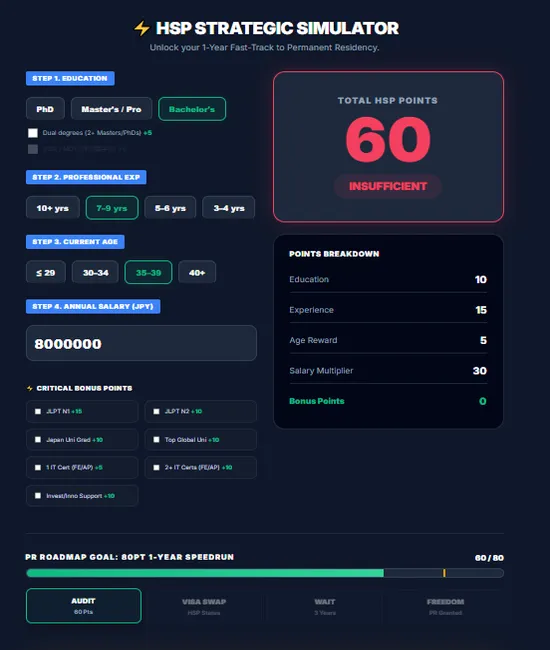
Before you do anything else, there’s one question worth answering first, because it changes your entire timeline: are you eligible for the Highly Skilled Professional (HSP) points-based fast-track?
Let’s calculate it first: High-Skilled Professional Visa Points Calculator.
It takes about five minutes, and the result determines which sections of this guide actually apply to you. If you can score 70 points, you can apply for PR after just 3 years of residence instead of 10, and at 80 points, that drops to 1 year. If you’re sitting at 80 points and didn’t know it, the rest of this article becomes a “what to prepare in the next 12 months” document instead of a “wait out the next decade” document. That’s not a small difference.
This article picks up after that point, assuming you now know roughly which lane you’re in (10-year route, 3-year route, 1-year route, or spouse route) and want to know what actually happens between now and the day you have a PR stamp in your passport.
The 2026 Rulebook for Permanent Residency in Japan Changed — and Most Articles Online Are Already Out of Date
Here’s where I need to flag something important, because a lot of the PR guides you’ll find online were written before February 2026, and the landscape has shifted enough that following last year’s advice could actively hurt your application.
On February 24, 2026, Japan’s Immigration Services Agency (ISA) revised the PR guidelines in three meaningful ways:
1. The 5-year visa requirement is becoming the standard, ahead of full enforcement in April 2027.
Previously, holding a 3-year Engineer/Specialist visa was enough to apply for PR. As of the February 24, 2026 revision, the 5-year period of stay is positioned as the new baseline, with a transitional measure running until March 31, 2027. In practice, this means: if you’re on a 3-year visa, you can technically still file during the transition window, but you’re filing into a climate of sharply increased scrutiny, with examiners actively cross-checking the kind of records discussed below. From April 1, 2027, holding the 5-year status is expected to become a hard requirement with no transitional exception. The practical takeaway for anyone planning ahead in 2026 is the same either way: treat “get to the 5-year visa tier first” as the default strategy, not a fallback. If your current visa renewal is realistically achievable before your PR timeline, sequence it first; the transitional measure is a narrowing window, not a long-term option to plan around.
2. Tax and pension records are now cross-checked, and “eventually paid” no longer counts as “paid.”
This is the change that’s catching the most people off guard. Historically, if you were a month late on your national pension or health insurance and then caught up, that was treated as a non-issue. Under the 2026 guidelines, ISA now runs cross-checks against the National Tax Agency and Japan Pension Service, and a late payment (even one fully resolved years ago) is logged as a negative factor. The standard now is essentially: on time, every time, not paid in full eventually.
3. There’s a revocation framework coming in April 2027.
This one matters less for your application today and more for your mindset going forward: once you have PR, the revised Immigration Control Act will allow authorities to revoke it for deliberate non-payment of taxes or social insurance. The bar for “deliberate” is reasonably high (it explicitly excludes situations like unemployment or illness), but it signals where enforcement priorities are heading. PR is no longer a “set it and forget it” status the way it used to be.
If you take one thing away from this section, make it this: before you touch the application form, pull your own pension and tax records and audit them yourself. Don’t assume your payroll department handled everything correctly, especially across job changes. We’ll come back to exactly how to do this in the traps section below.
The Three Legal Pillars, Translated Out of Legalese
Every official explanation of permanent residency eligibility in Japan comes back to three pillars. They’re usually written in language that sounds like it was translated by someone who’s never had to actually live under it, so let me translate them again, this time into the language of someone with a residence card and a commute.
Pillar 1: “Good Conduct” (素行善良)
In plain terms: no criminal record, no major tax or social insurance delinquencies, and (this is the one people underestimate) no significant traffic violations. A single parking ticket won’t sink you, but a pattern of unpaid violation fines, or anything that escalated to a fine (罰金) rather than just a warning, gets reviewed. If you’ve had any brush with the law in Japan, even something that felt minor at the time, it’s worth discussing with an immigration lawyer before you file, not after a rejection.
Pillar 2: “Independent Livelihood” (独立生計)
This is about whether you (and your dependents) can sustain yourselves financially without relying on public assistance. In practice, this is mostly evaluated through your tax filings and income history, typically the last 3-5 years, depending on your route. The number that gets thrown around informally is an income level comfortably above ¥3 million annually, though there’s no single hard line written into law; what matters more is stability and consistency of income, and whether your tax filings actually reflect it accurately.
For freelancers and sole proprietors, this is where things get harder, because your income history is self-reported and self-managed. If your declared income has been volatile, or if you’ve been aggressively minimizing your taxable income through deductions (which is completely legal for tax purposes), you may be technically compliant with tax law while still presenting a weaker “independent livelihood” case than a salaried employee with the same take-home pay. There’s a real tension here between optimizing for tax efficiency and optimizing for PR approval, and it’s worth thinking about which one matters more to you in the 1-2 years before you apply.
Pillar 3: “Conforms to Japan’s Interests” (国益適合)
This is the broadest and most discretionary pillar, and it’s where the residence history, visa category, and “contribution to Japan” narrative all live. It includes things like: having the maximum-duration visa status (the new 2026 requirement we discussed), having a guarantor (more on this below) and, for some categories, demonstrating some level of integration (tax payment, social insurance enrollment, sometimes Japanese language ability depending on the route).
Permanent Residency Routes in Japan: What the 2026 Rules Add On Top of Your Points
If you’ve already run the calculator, you know roughly which lane you’re in: 10-year route, 3-year route (70 points), or 1-year route (80 points). The HSP Points Calculator article covers the points-to-timeline mapping in detail, so I won’t repeat that table here. What it doesn’t cover, because it’s brand new, is the layer of 2026-specific requirements that now sit on top of whichever route you’re on, regardless of your score.
| Route | What changed under the Feb 2026 guidelines | Practical effect |
| Standard (10-year route) | 5-year visa status is now the expected baseline (transitional measure runs through March 31, 2027) | If you’re on a 3-year visa at year 9-10, weigh a visa renewal cycle before your PR filing rather than assuming the transitional measure covers you |
| HSP points route (70 or 80) | Same baseline shift applies: the fast-track shortens residence time, not the expectation around visa-status duration | Even an 80-point applicant filing after 1 year benefits from confirming their HSP visa is issued at the 5-year duration where possible |
| Spouse of Japanese national | Guarantor and tax/pension cross-check requirements apply identically to this route | Immigration is explicitly watching for “marriage of convenience” patterns. Divorces shortly after PR approval raise red flags for similar future applicants |
Two details apply across every route, no matter your score:
The guarantor requirement. Every PR application needs a guarantor — typically a Japanese national or a non-Japanese national who already holds PR. The HSP visa application itself doesn’t require this; the PR application does, even on the 1-year fast-track. We’ll cover why this catches people off guard in the traps section below.
The “must be sustained” trap for points-based applicants. I’ve seen cases where someone hits 80 points, gets excited, and then takes a slightly lower-paying job for better work-life balance six months before filing — not realizing that drop could take them under the threshold and reset their qualifying period. On the fast-track, your point total isn’t a one-time achievement you unlock and move on from; it’s a number you keep maintaining until the day you file.
Five Traps That Catch Engineers Specifically When Applying for Permanent Residency in Japan
These are the issues I see come up again and again with people in technical roles — partly because of how often engineers change jobs, work across borders, or operate as freelancers/contractors. None of these are exotic. All of them are avoidable if you catch them early.
1. The pension gap during a job transition.
When you change employers in Japan, your pension and health insurance enrollment is supposed to transition seamlessly from one company’s shakai hoken (社会保険) to the next. In practice, there’s often a gap of a few weeks to a couple of months between when your old employer’s coverage ends and your new employer’s coverage begins, especially if there’s any delay in paperwork, or if you take time off between jobs. During that gap, you are required to enroll in National Health Insurance (国民健康保険) and National Pension (国民年金) yourself. Almost nobody does this, because nobody tells you it’s your responsibility, and because the gap feels too short to matter.
Under the pre-2026 standard, this often went unnoticed. Under the current standard, this shows up as a payment gap when ISA cross-references your records. Remember,, “eventually resolved” no longer helps you.
💡The fix: if you’ve changed jobs in the last several years, pull your pension record (年金記録) from the Japan Pension Service: you can request this directly, or check it through the Nenkin Net portal — and look for any gap months. If you find one, talk to a lawyer about how to address it before you apply, because the options for retroactively fixing a multi-year-old gap are limited and time-sensitive.
If you’re currently mid-transition — say, moving from a salaried role to freelance — the social insurance overhead changes the moment your employment status changes, not at some later administrative date. The HSP visa guide covers this JTC-to-freelance switch in more depth if that’s the situation you’re in; the short version for PR purposes is that the gap described above is exactly where it tends to open up.
2. Misreading “continuous residence” with overseas trips.
If your job involves frequent business travel, conferences, client visits abroad, or extended remote work from your home country, you need to understand how absences from Japan affect your residency clock. The general guidance is that a single trip shouldn’t exceed roughly 3 months, and your cumulative time outside Japan shouldn’t exceed roughly half the relevant period — but these aren’t bright-line rules you can rely on without documentation. The 2026 guidelines apply stricter scrutiny to overseas absences than before.
💡The fix: start keeping a simple log now: boarding passes, hotel confirmations, even calendar entries that document your re-entry dates. If you’ve had a stretch of heavy travel (a multi-month secondment, an extended stay caring for family abroad, a long “working from my home country” period during a transition), get ahead of it. Don’t wait until the application to try to reconstruct two years of travel history from memory.
3. Furusato Nozei and tax filing inconsistencies.
Furusato Nozei (the “hometown tax” donation system) is popular among salaried workers in Japan, and it’s completely legitimate — but it does require that you actually file the paperwork correctly (either the one-stop exception system or through your annual tax return). If you’ve made furusato nozei donations but the paperwork didn’t get filed correctly — which happens more often than people realize, especially if you donated to multiple municipalities and missed the one-stop system’s 5-municipality limit — your tax records may show a discrepancy between what you paid and what’s officially recorded.
This usually isn’t a “you owe back taxes” situation; it’s more often a “your tax certificate doesn’t cleanly reconcile” situation. But when an immigration officer is doing a line-by-line review of your tax history, discrepancies, even harmless ones, invite questions you’d rather not field.
💡The fix: pull your tax certificate (納税証明書) and residence tax certificate (住民税の証明書) for the years you’ll be submitting, and check that they’re internally consistent before you submit anything. (If you’re unclear on how resident tax timing works in your first couple of years in Japan (it’s billed a year in arrears, which trips people up), the HSP visa guide walks through that timing in its financial section.)
4. Treating a 3-year visa as “good enough” because of the transitional measure.
I mentioned this above, but it deserves its own entry because it’s the single most common “I thought I was ready but wasn’t” scenario I expect to see throughout 2026 and 2027. People track their residence clock carefully (the 10-year count, or the 3-year/1-year point-based count) but don’t separately track their current visa’s period of stay. These are two different numbers. You can have 10 years of cumulative residence in Japan while currently holding a 3-year visa, and that combination puts you in the transitional category, where your application gets the increased scrutiny described above rather than a clean pass.
💡The fix: check your residence card right now. Look at the “period of stay” field. If it says anything other than 5 years, weigh whether a 5-year visa renewal is realistically achievable before your planned filing date. If it is, sequence it first; build it into your timeline before the PR filing, not in parallel with it. If it isn’t realistic on your timeline, that’s a conversation to have with an immigration lawyer about how the transitional measure applies to your specific case, rather than something to assume your way through.
5. The guarantor you haven’t thought about yet.
No documents are missing here — this is purely a planning gap. As mentioned in the Pillar 3 section, every PR application needs a guarantor — typically a Japanese national or a foreign national with existing PR — and that person needs to provide their own documents (proof of income, ID, etc.) and is making a real commitment by signing on.
For people who’ve built their social circle mostly with other foreign residents, or who’ve been in Japan for a relatively short time on a fast-track route, finding this person can take longer than expected. It’s not something you want to be sorting out in the final weeks before filing, when you also need that person to gather their own paperwork on a timeline that works for you.
💡The fix: have this conversation now, even if your application is 12+ months away. It’s a relationship ask, and those go better with lead time.
Building Your Permanent Residency Application in Japan: A Reverse-Engineered Timeline
Rather than giving you a generic document checklist (every immigration office’s exact requirements vary slightly, and your lawyer or the official ISA list will have the definitive version), here’s how I’d structure the timeline working backwards from your target filing date — which is the part that actually determines whether your application goes smoothly.
12 months out: Pull your pension record and check for gaps (Trap #1). Pull tax/residence tax certificates and check for consistency (Trap #3). Check your current visa’s period of stay (Trap #4): if it’s not 5 years and a renewal is realistic on your timeline, start that process now and sequence it ahead of your PR filing.
9-12 months out: Have the guarantor conversation (Trap #5). Start your travel log if you haven’t already (Trap #2). If you’re on a points-based route, document your current point total with supporting evidence — salary certificates, degree certificates, employment history — even if you’re not filing yet, so you have a clean snapshot of where you stand.
6 months out: If your 5-year visa renewal is in progress, this is roughly when you’d expect a decision, depending on category, and your PR filing date should be sequenced after that approval comes through, not in parallel with it. This sequencing is the part most generic checklists don’t account for, because it’s specific to the 2026 guideline change. Once your visa status is confirmed, begin assembling the core PR document set: residence card, passport, tax certificates (typically multiple years), employment certificate, income/tax withholding statements, and the reason for application (理由書).
3 months out: Do a full internal audit. This is the point where I’d strongly recommend having an immigration lawyer or licensed administrative scrivener (行政書士) review the full package — not because you can’t fill out the forms yourself, but because they’ve seen the specific failure patterns that ISA is currently flagging, and that pattern recognition is worth the fee. Given the 2026 emphasis on tax/pension cross-checks, a second set of eyes on your payment history specifically is money well spent.
Filing: Submit at your local immigration office. Note that fees are also part of the 2026 changes: expect the PR application fee to be meaningfully higher than in previous years (figures discussed in current proposals are in the range of ¥100,000, up from the previous ¥8,000, though confirm the current fee at filing time since this is still being finalized).
What Happens After You File — and What If You’re Rejected?
Standard processing time for PR applications has historically run anywhere from a few months to over a year, and there’s no fast way to check status mid-review; you simply wait. Under the increased scrutiny of 2026, I’d plan for the longer end of that range rather than the shorter end.
If you’re rejected, you’ll typically receive a notice without a highly detailed explanation of the reasoning — sometimes just a general category (e.g., insufficient continuous residence, tax/pension issues, insufficient income stability). This is one of the harder parts of the system: you’re debugging a failure with limited visibility into the actual error log.
There’s no formal appeal process for PR denials, but you can reapply, and a second application, prepared with a clear understanding of what likely went wrong the first time, often succeeds. If you’re rejected, this is the point where working with an immigration lawyer stops being optional in my view. They can often get a more candid read on the likely issue through informal channels than what’s stated in the rejection notice itself, and that information is what separates “reapply with the same package” from “reapply with the actual problem fixed.”
A Closing Thought, From One Systems Person to Another
It took me a while to internalize this about diagnostic work: the system doesn’t care about your intentions. A car with a misfiring cylinder isn’t being judged on whether the driver meant to maintain it properly; the ECU just reports what it measures. Japan’s PR system, especially post-2026, is moving in a similarly literal direction. It cares less about your narrative (“I’ve contributed to this company for a decade, I pay my taxes, I’m basically Japanese at this point”) and more about whether your actual records (pension contributions, tax filings, visa status, residence days) line up cleanly with what the rules require.
I don’t think this is necessarily a bad thing, even though it’s clearly more demanding than the system used to be. A rules-based, document-driven process is at least consistent — if your records are clean, the outcome is predictable in a way that a more discretionary, “make your case” system never could be. The frustrating part is that most people don’t find out their records aren’t clean until the worst possible moment: during the review itself, when fixing the problem retroactively may no longer be an option.
So if there’s one piece of advice I’d want you to walk away with, it’s this: treat your residency status the way you’d treat a production system you’re responsible for — with monitoring, not just hope. Check your pension record. Check your tax certificates. Check the period of stay on your residence card. Do it today, regardless of how far away your PR application is. The earlier you catch a discrepancy, the more options you have to fix it — and the version of you filing the application in a year will thank the version of you who ran the diagnostics today.
Conclusion: How to Get Permanent Residency in Japan
There’s no shortcut around the paperwork, but there is a shortcut around the waiting, and for a lot of engineers, that shortcut is the HSP points route most people never check. Whichever lane you’re on, the 2026 rules reward people who audit their tax, pension, and visa status early and penalize people who assume everything’s fine. Start with the calculator, run your own diagnostics on your records, and build your timeline backward from there. Do that, and PR stops being a vague decade-long hope and becomes a project with a date on it.
This article is intended as general information as of 2026 and does not constitute legal advice. Immigration Services Agency guidelines and application fees are subject to change without notice. Before applying, please confirm the current requirements on the official Immigration Services Agency of Japan website, or consult a qualified immigration lawyer or licensed administrative scrivener (行政書士).
This article is a sub-module of Layer 3. To master the complete career optimization protocol or explore the entire blueprint, choose your next destination:
🔼 Back to Layer 3: Career Strategy & Hacking Seniority (Return to the module overview: Salary Negotiation, Visa Hacks, and Promotion Logic)
🏠 Return to The Engineer’s Blueprint: Decoding Japanese Workplace Culture (Access the Master Manual including Genba Communication, Tech Specs, and Business Etiquette)
📥 DOWNLOAD IT FOR FREE