
Japanese Traditional Companies (widely known as JTCs) possess world-class technological capabilities, yet they are governed by unique “unspoken rules” and complex bureaucratic procedures. For foreign developers (Foreign Devs), the decision to leave such a company often brings confusion due to the procedural differences and the immense cultural pressure involved.
In this article, I will share my firsthand experiences as a former OBD engineer to provide a clear, step-by-step guide on how to quit a job in Japan, including the key difference between taishoku negai vs taishoku todoke, while decoding the essential terminology you need to know.
The Exit Strategy: How to Quit a Job in Japan as a Foreign Dev
When you decide to leave a Japanese company, simply telling your boss “I quit” is often a recipe for trouble. In Japanese business culture, Enman Taishoku (resigning harmoniously without causing friction) is highly recommended. Therefore, understanding the correct process of how to quit a job in Japan and acting strategically is essential.
Step-by-Step: How to Quit a Job in Japan
If you are unsure how to quit a job in Japan properly, the process generally follows a predictable sequence in most Japanese companies.
Step 1: Inform your direct supervisor privately, ideally one to two months before your planned resignation date.
Step 2: If the company requests it, submit a Taishoku Negai (resignation request) during the consultation stage.
Step 3: Discuss and finalize your resignation date with your manager and HR department.
Step 4: Submit the official Taishoku Todoke (resignation notification) once the resignation date is confirmed.
Step 5: Complete the handover process (Hikitsugi) and schedule the use of your remaining paid leave (Yukyu).
Understanding the Legal Notice Period When You Quit a Job in Japan
Under Japanese Civil Law, permanent employees (those on indefinite contracts) can legally resign by giving notice at least “two weeks” in advance. However, the “Common Sense” of JTCs and internal work rules usually stipulate that you should notify the company “one to two months before your resignation.” Considering the time needed for handovers and hiring a successor, leaving in only two weeks—the legal minimum—is viewed as a highly aggressive stance in Japan. To avoid unnecessary trouble, the safest first step is to convey your intent directly to your immediate supervisor (or in a 1-on-1 meeting) one to two months in advance.
Avoiding the Counter-Offer Trap: Why You Must Remain Firm
When you express your desire to leave, the more talented you are as an engineer, the higher the probability you will face a strong “Counter-Offer.” It is a typical JTC pattern to appeal to your emotions with phrases like “We’ll raise your salary,” “We’ll transfer you to your preferred project,” or “The team will collapse if you leave.” However, you must not waver. Once someone has shown an intent to resign, the company often treats them as a “flight risk” who might leave again, which can be disadvantageous in the long run. A firm stance of “My decision is final” is a necessary block.
Taishoku Negai vs Taishoku Todoke: Decoding the Formal Paperwork
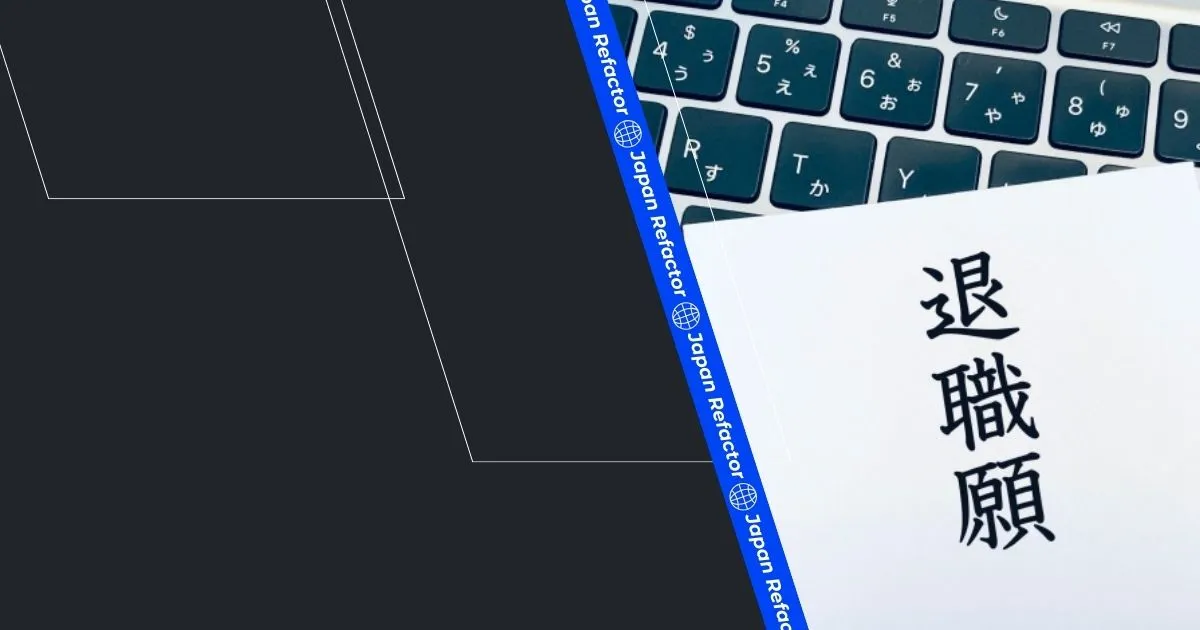
When conveying your intent to resign, Japanese business professionals use two different documents: “Taishoku Negai” and “Taishoku Todoke.” Failing to understand the difference in taishoku negai vs taishoku todoke can lead to mistakes, such as having to redo procedures or having your resignation finalized at an unintended timing.
Which One to Use? The Difference Between Requesting and Notifying
In short, these two have completely different “legal natures.”
- Taishoku Negai (Resignation Request): A document to “Request” the company, saying “May I please resign on [Date]?” It is submitted during initial consultations or at the start of negotiations. It can be withdrawn (cancelled) as long as the company has not yet accepted it.
- Taishoku Todoke (Resignation Notification): A “Notification” of a fixed decision, submitted after discussions with your boss are finished and the resignation date is officially set. This is a unilateral declaration stating “I am resigning on [Date]” and, once accepted, generally cannot be withdrawn.
The “most beautiful” step in Japan is to first consult verbally, submit a Taishoku Negai if requested, and finally submit a Taishoku Todoke once everything is decided (check with HR as some companies have specific formats).
A Step-by-Step Template for Writing Your Resignation in Japanese
It is proper etiquette to handwrite or print these documents on plain white paper and submit them in a plain white envelope. The basic structure is as follows:
- タイトル (Title): 「退職願」または「退職届」 (Either “Taishoku Negai” or “Taishoku Todoke”)
- 導入 (Introduction): 私事(わたくしごと)ではございますが、 (Translation: “This is a personal matter, but…”)
- 退職理由 (Reason for Resigning): 一身上(いっしんじょう)の都合により、 (Translation: “Due to personal circumstances…” — This is the most professional and safest phrase to use regardless of your actual reason.)
- 日付と意志 (Date & Intent): 令和〇年〇月〇日をもって退職いたしたく、ここにお願い申し上げます。 (Translation: “I would like to resign as of [Date], and I hereby make this request.”)
- 署名 (Signature): 自分の部署名、名前、捺印(ハンコ) (Your department name, full name, and your seal/Hanko.)
- 宛名 (Addressee): 提出するタイミングでの会社の最高経営責任者(社長)のフルネーム (The full name of the company’s CEO at the time of submission.)
Setting Workplace Boundaries When Quitting a Job in Japan
The months between the decision to resign and your actual departure are when Setting Workplace Boundaries becomes most difficult. The company will pressure you to finish as much work as possible before you leave.
Handling the Handover (Hikitsugi) Without Overworking
When I left my job as an OBD engineer, the most difficult part was the Hikitsugi (handover). It’s often misunderstood, but for a permanent engineer at a JTC, the essence of a handover is not explaining source code. This is because program implementation and error logic construction are usually the work of suppliers.
The real challenge was passing on the “company-specific protocols” accumulated over many years. “Which key person in which department needs to nod so the project doesn’t stop?”, “Where is the formal delivery location for specifications?”, “Which quality-check rituals (approval flows) are formalised but mandatory?” Passing this mesh of undocumented, gritty human relationships and processes to a successor was tough.
I felt silent pressure from my boss to “prepare perfect handover materials before leaving,” and my overtime for coordination was about to skyrocket. However, the essence of a handover is not to create a “clone” of yourself. It is to “transfer the minimum information and decision-making authority needed for operations to continue.” You must have the courage to stand as a professional and act logically—prioritize documentation for “practical workflows” and draw a clear line by saying, “Further verbalization of tacit knowledge is impossible.”
Resisting Unpaid Overtime and Use of Paid Leave (Yukyu) Before Leaving
In Japan, “Yukyu” (Paid Leave) is a legally protected right. It is a worker’s legitimate right to use all remaining leave before leaving the company. However, some JTCs may try to obstruct your leave by asking, “Are you going to rest even though the handover isn’t finished?” or force Service Zangyo (unpaid overtime) in the final month. Here too, it is vital to draw clear boundaries, visualize your remaining workdays and handover schedule, and dryly complete only what can be done within the period until your paid leave begins.
Conclusion: Your Next Step Toward Career Freedom Outside the JTC
Navigating resignation procedures within Japanese corporate culture takes a lot of energy. If you can understand the difference between Taishoku Negai and Taishoku Todoke, resist peer pressure, use your paid leave, and leave the company harmoniously, you have mastered a key skill in Japanese business survival. For your next career, please choose an environment that respects both your technical skills and your private time.
Action Step: Sign Up with a Tech Recruitment Agency to Secure Your Next Role
The best defense against strong counter-offers or disadvantageous negotiations is to “already have a job offer (Job Offer) for your next role.” Before telling your boss you want to quit, consult a professional agent to secure your future career.
💼 Recruitment & Resignation Support (Safe Exit and Next Career) To find excellent companies—such as foreign-affiliated firms or modern mega-ventures—that properly evaluate the abilities of bilingual engineers and offer high compensation, we recommend using IT and global-specialized agents found at “5 Best Recruitment Agencies for Software Engineers in Japan“
😲 Emergency Option: “Taishoku Daiko Services“ In extreme cases where “the boss won’t accept the resignation” or “threatens you with damages if you quit,” do not face it alone. Consider using a Taishoku Daiko Service. A lawyer or labor union will negotiate with the company on your behalf, handling same-day resignation and negotiations for paid leave. For foreign engineers with high psychological barriers, this is a reliable and safe “escape route” to cut ties with a company.
This article is a sub-module of Layer 3. To master the complete career optimization protocol or explore the entire blueprint, choose your next destination:
🔼 Back to Layer 3: Career Strategy & Hacking Seniority (Return to the module overview: Salary Negotiation, Visa Hacks, and Promotion Logic)
🏠 Return to The Engineer’s Blueprint: Decoding Japanese Workplace Culture (Access the Master Manual including Genba Communication, Tech Specs, and Business Etiquette)
📥 DOWNLOAD IT FOR FREE