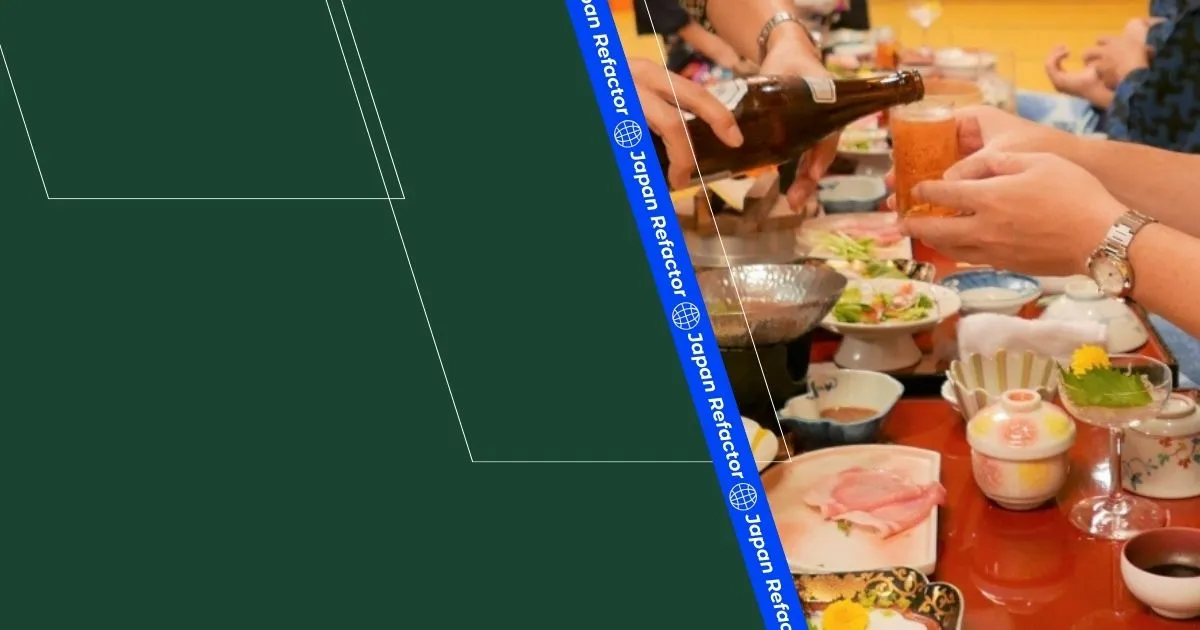

For engineers working in Japan, your technical “hard skills” are only half the equation. The other half is an informal communication channel known as “Nomikai” (drinking parties).
To many expats in Japan, these after-work gatherings might look like simple socializing.
However, within the Japanese organizational structure, a Nomikai is a high-efficiency environment where “important packets” that never flow in official meetings are exchanged through informal communication channels.
Back when I was an OBD (On-Board Diagnostics) engineer for a major automaker, I constantly hit “implicit local rules” that weren’t in any spec sheet. The solutions weren’t found at my desk, but in conversations over a drink after work.
This article explains how to “hack” Japanese business culture from an engineer’s perspective.
Beyond Japanese Business Manners: Decoding the Undocumented Features of Socializing
At first glance, Japanese business manners might seem like a complex, inefficient “legacy specification.” However, they function as implicit rules designed to maintain system stability.
When engineers implement a new library, we often struggle with “undocumented features.” Japanese social etiquette is the same.
Whether it’s the specific angle of a bow or the logic of seating arrangements (Kamiza/Shimoza), these are all handshake protocols used to verify “privilege levels” and prevent communication errors.
These hidden social rules ensure the network remains stable before data transmission begins.
Social Interface Guidelines: Why Your Code is Great but Your Career Stalls
If you feel like your code is perfect yet your projects never get approved, or your career stalls despite your technical prowess, you might have a bug in your implementation of business social etiquette.
In a Japanese workplace, your technical skill is the backend logic.
But if the “frontend” (your social interface) is poorly implemented, the users (colleagues and managers) won’t render your value correctly.
A Nomikai is the perfect debugging opportunity to tune this interface and reduce latency between you and the rest of the team.
Parsing High-Context Culture: The Logic Behind Nemawashi and Ringi System
flowchart LR
    subgraph Office["🏢 Office Environment"]
        O1["Message Payload<br/>+ Encrypted Headers<br/>(facial expression, tone)"]
        O2["High-Context Protocol<br/>= Hard to Parse"]
    end
    subgraph Nomikai["🍺 Nomikai Environment"]
        N1["Message Payload<br/>+ Plaintext Headers<br/>(relaxed, direct)"]
        N2["Low-Context Protocol<br/>= Easy to Parse"]
    end
    O1 --> O2
    N1 --> N2
    O2 -->|"Packet Loss Risk:<br/>HIGH"| RESULT1["❌ Misunderstanding"]
    N2 -->|"Packet Loss Risk:<br/>LOW"| RESULT2["✅ True Intent<br/>Received"]
    style Office fill:#fee2e2,stroke:#dc2626
    style Nomikai fill:#d1fae5,stroke:#059669
    style RESULT1 fill:#fee2e2,stroke:#dc2626,color:#991b1b
    style RESULT2 fill:#d1fae5,stroke:#059669,color:#064e3b
The Japanese business environment is an extremely high context culture — meaning the packet headers (context, relationships) often carry more critical data than the payload (actual words). Nemawashi and the
Ringi system function as “Dependency Resolution” — pre-aligning stakeholders before the main process.
At a Nomikai, these implicit packet headers become simpler to parse.
The relaxed environment lets you debug context that’s invisible in formal meetings.
→ Deep dive into Ringi & Nemawashi protocols : What is the Ringi System & Process? Guide for Engineers in Japan
The Nomikai Debugger: Survival Japanese Phrases for the Tech Genba
graph LR
    subgraph MODE [🍻 Protocol Switch]
        Work[👔 Office Mode] -- Kanpai! --> Drink[🍺 Nomikai Mode]
        Drink -- Last Train --> Work
    end

    %% Invisible Link to force layout
    Drink ~~~ Door

    subgraph SEAT [🪑 Kamiza Logic]
        Door[🚪 Door / Exit] --- Low[⬇️ Shimoza / Junior]
        Low --> High[⬆️ Kamiza / Boss]
    end

    style Work fill:#e5e7eb,stroke:#374151
    style Drink fill:#d1fae5,stroke:#059669
    style High fill:#fef3c7,stroke:#d97706
    style Low fill:#dbeafe,stroke:#2563eb
To survive the Japanese development “Genba” (the actual workplace), mastering survival Japanese phrases used in the local runtime is a much faster route than studying textbook Japanese.
During my time as an OBD engineer, I was once stuck debugging a complex emission control issue.
I was staring at unexpected error logs that only appeared under specific conditions. No matter how much I read the documentation, the project was in a total deadlock.
Then, at a Nomikai, a veteran engineer with a beer in his hand said:
“Why don’t you just ‘Nekaseru’ (put it to sleep) that process for now, and ‘Nigiru’ (grasp) the specs with the upstream team first?”
That one sentence cleared my vision instantly.
- “Nekaseru” (Put to sleep): Suspend/Background process. (Put it on the shelf for a cooling-off period rather than trying to solve it immediately.)
- “Nigiru” (Grasp/Grip): Standardize / Final Agreement. (Create a point of no return by getting everyone on the same page.)
I was obsessed with fixing the bug (refactoring code), but the true bottleneck was an external dependency—alignment with the upstream team. Learning this Japanese technical vocabulary in the “low-latency” environment of a Nomikai is an invaluable debugging tool.
Breaking Language Barriers: From “Kento Shimasu” to 403 Forbidden
To start breaking language barriers, let’s map common Japanese phrases to concepts engineers already understand.
| Japanese Phrase | Engineering Interpretation | Actual Status (True Meaning) |
| Kento shimasu (検討します) | 403 Forbidden | Effectively “NO.” A firewall preventing further requests or inquiries. |
| Tekigi (適宜) | Conditional Execution | Modern “Yoshinani.” Execute logic based on your local judgment of the runtime. |
| Mochikaerimasu (持ち帰ります) | Request Timeout | Buffering. Cannot process this locally right now. Will process asynchronously later. |
| Naru-haya (なる早で) | High Priority Queue | “As soon as possible.” Deadline undefined, but move to the front of the queue. |
| Batabata shiteite (バタバタしていて) | CPU 100% Usage | Resource Exhaustion. No available threads to handle your request right now. |
| Nigiru (握る) | TCP Handshake | Consensus. Finalizing a commit on specs or conditions with stakeholders. |
| Nekaseru (寝かせる) | Suspend | Freeze. Put the task in a sleep state to wait for a better environment. |
Mapping ambiguous Japanese to logical status codes drastically reduces communication bugs.
→ Full decoder for all Japanese business phrases : The “Yes, but No” Dictionary: Decoding Japanese Business Phrases
Optimizing Indirect Communication Styles: A Protocol for Developers
Japanese indirect communication styles might seem to have poor transmission efficiency. However, this is an optimization designed to minimize load on the “human relationship server” and prevent packet loss (emotional conflict).
At a Nomikai, you are allowed to “downgrade” this protocol. Even the strictest boss is likely to accept more direct information exchange when alcohol acts as a catalyst.
Mastering Keigo: Implementing State Machines in Your Business Conversations
Keigo (honorifics) is a nightmare for learners, but you can master it by viewing it as a “State Machine.” Define the “Role” and “Group” of yourself and your interlocutor as States, and switch the “Method” (speech style) accordingly.
- Sonkeigo (Respectful): The “Getter/Setter” used when accessing the private variables of another object.
- Kenjougo (Humble): A system call to set your own object’s priority to “Low.”
With this state machine in mind, you can implement the correct Keigo without constantly checking a Keigo cheat sheet.
Conclusion: Merging into the Japanese Ecosystem via Social Version Control
Adapting to Japanese workplace culture is like contributing to a major open-source project. No matter how great the code is in your local branch, it has no value until it is “Merged” into the main branch.
The Nomikai is the “Pull Request” environment—the place where you send your PRs and get them reviewed. Once you are merged, your proposals will propagate through the entire system with surprising smoothness.
Don’t view the Nomikai as a waste of time; see it as the “Synchronization Process” for your career. To optimize this process, you need both a defensive and offensive setup:
・Defensive Layer : Master your work-life boundaries with our Engineer’s Exit Strategy for Nomikai Culture.
・Offensive Layer : Learn deep-layer organizational hacking in our advanced guide: Nomikai Adaptive Interfaces: Decoding the Social Dynamics of JTC Dev Teams.
Next Steps: Level Up Your Navigation
This article is a sub-module of Layer 1. To master the complete communication protocol or explore the entire career blueprint, choose your next destination:
🔼 Back to Layer 1: The Logic of Communication at Genba (Return to the module overview: Ringi, Nemawashi, and Genba Interaction)
🏠 Return to The Engineer’s Blueprint: Decoding Japanese Workplace Culture(Access the Master Manual including Technical Japanese, Career Strategy, and Business Etiquette)
📥 DOWNLOAD IT FOR FREE