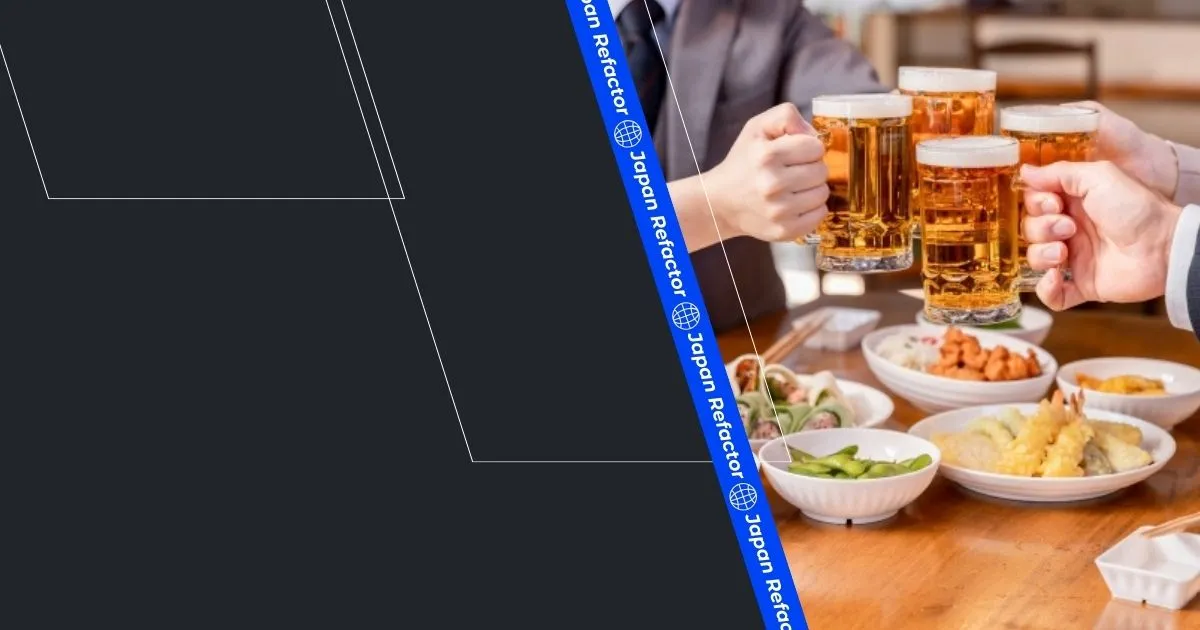

In a Japanese professional environment, a Nomikai culture event is not just about consuming alcohol; think of it as an Informal debug session.
While the daytime office environment relies strictly on “Documentation” (formal manuals), the Nomikai is where the raw logs are leaked. This is where you hear the real “heart of the matter,” such as, “To be honest, that project is seriously lacking resources.”
However, for any engineer, the most critical task is resource management to maintain performance for the following day. You don’t need to stay for the “Nijikai” (second party) or “Sanjikai” (third party) that drags on into the midnight hours. Master a strategic Exit Strategy to catch the necessary data packets and terminate the session cleanly without crashing the system.
High-Context Culture: Japanese Drinking Parties & Contextual Communication Skills
Communication in Japan is a High-context culture, where a significant amount of information is conveyed without words. From an engineering perspective, this is a system with a heavy reliance on Shared Memory.
Detect the Termination Flag via Contextual Parsing
flowchart LR
  %% Horizontal Layout for Process Flow
  %% Input -> Logic -> Action

  subgraph INPUT ["📡 Scan Context"]
    direction TB
    DATA1["📉 Glass Rotation<br/>(Slow?)"]
    DATA2["🔁 Topic Loop<br/>(Repeating?)"]
  end

  subgraph LOGIC ["🧠 Parse Status"]
    direction TB
    CHECK{{"Exit Flag<br/>Detected?"}}
  end

  subgraph OUTPUT ["🏃 Action"]
    direction TB
    EXIT["🚪 Trigger Exit<br/>('See ya')"]
    STAY["🍺 Stay<br/>(Keep Listening)"]
  end

  %% Connections
  DATA1 & DATA2 --> CHECK
  CHECK -- "Yes (Flag=1)" --> EXIT
  CHECK -- "No (Flag=0)" --> STAY
  STAY -.-> INPUT

  %% Styling
  style INPUT fill:#f8fafc,stroke:#94a3b8,color:#334155
  style LOGIC fill:#eff6ff,stroke:#2563eb,color:#334155
  style OUTPUT fill:#f0fdf4,stroke:#16a34a,color:#334155

  style CHECK fill:#fff7ed,stroke:#f97316,color:#c2410c,shape:diamond;
What Japanese people call “reading the air” (Kuuki wo yomu) is essentially Contextual Parsing of your surroundings. Do not miss the “Termination Flags” that signal an opportunity to exit the Nomikai:
- Decreased Glass Rotation: When the frequency of drink orders drops, the session is approaching a “Timeout.”
- Topic Looping: When new data input stops and the group starts reading from the same memory address (repeating the same stories), you have reached an exit point.
When the logic of the conversation begins to break down as people get drunk, that is your flag to trigger the exit sequence. In my experience, once this point was reached, critical information rarely appeared afterward.
Implementing Social engineering tactics for a Healthier Work Life Boundary
To protect your work life boundary, you sometimes need to employ social engineering tactics—psychological hacks to set boundaries without causing friction. Here are the specific steps:
- Setting a Pre-flag (Pretexting):
A few hours before the party starts, set a “Pretext” by mentioning, “I have a deployment (or a critical test) first thing tomorrow morning.” - Visualizing Alerts:
Set an alarm on your smartwatch. When it vibrates, act as if you received a “Server Monitoring Alert” or an urgent ping from home.
Business Social Etiquette: Building Your Pre-Exit Permission (Root Access)
In business social etiquette, the smartest way to leave is “Nemawashi” (prior grounding). This is very similar to gaining Root Access in an IT system.
Declaring “I will be leaving after the first round” the moment the party starts is increasingly accepted in many companies as a “new standard of etiquette. “By declaring this early, you prevent “Interrupts” (people asking why you are leaving) from occurring later in the execution.
Practical Business Japanese for Ending the Session
You don’t need to memorize complex honorifics to close a session. Treat it as a State Machine and trigger the appropriate “Executable Code” (phrases) when specific events occur. This is the core of practical business japanese.
| System Status | Executable Code (Phrase) | Meaning |
| Initiate Exit | そろそろ失礼します (Sorosoro shitsurei shimasu) | I’ll be leaving soon. |
| Send Gratitude | 今日はありがとうございました (Kyo wa arigatou gozaimashita) | Thank you for today. |
| Terminate Session | 明日が早いので、これで上がります (Ashita ga hayai node, kore de agarimasu) | I have an early start tomorrow, so I’m heading out. |
The “O-saki-ni” Function: Japanese Honorifics as Logic
flowchart LR
  %% Decision Tree for Leaving Greeting
  %% Horizontal Layout

  START(("🏁 Initiate<br/>Exit"))

  CHECK{{"👤 Target<br/>Status?"}}

  RESULT_BOSS["👔 Boss / Senior<br/>'O-saki ni<br/>Shitsurei shimasu'"]
  RESULT_PEER["🍺 Peer / Junior<br/>'Otsukare!<br/>Mata ashita'"]

  %% Connections
  START --> CHECK
  CHECK -- "Boss / Senior" --> RESULT_BOSS
  CHECK -- "Peer / Team" --> RESULT_PEER

  %% Styling
  style START fill:#1e3a5f,stroke:#2563eb,color:#ffffff,stroke-width:2px;
  style CHECK fill:#fff7ed,stroke:#f97316,color:#c2410c,shape:diamond;

  style RESULT_BOSS fill:#eff6ff,stroke:#2563eb,color:#1e3a5f
  style RESULT_PEER fill:#dcfce7,stroke:#16a34a,color:#14532d
As shown in the diagram above, the phrase “O-saki-ni shitsurei shimasu” is more than a greeting; it’s a function with transformation logic based on the target’s status.
This is how you should view Japanese honorifics. By simply switching the output (Syntax) based on whether the target is a “Boss” or a “Peer,” your Japanese will become dramatically more natural.
Conclusion: Master Your Work-Life Boundary in Japan
A strategic exit is not “insincere” to your team. Rather, it is a maintenance operation to keep your code quality high the next day and ensure the system (project) continues to run normally.
When I worked as an OBD engineer at an automaker, the diagnostic logic written by engineers exhausted from unpaid overtime and excessive drinking almost always contained “bugs.” The secret to long-term career success in Japan lies in strictly managing your own resources to maintain your work life boundary.
Once you’ve secured your personal time, you can learn how to leverage the rare sessions you do attend for maximum career impact in our advanced guide: Nomikai Adaptive Interfaces: Decoding the Social Dynamics of JTC Dev Teams.
Utilize these Exit Strategies to make your life as an engineer in Japan the best it can be!
Next Steps: Level Up Your Navigation
This article is a sub-module of Layer 4. To master the complete business etiquette protocol or explore the entire career blueprint, choose your next destination:
🔼 Back to Layer 4: Structural Japanese & Business Etiquette (Return to the module overview: Keigo, Email Protocols, and Office Life)
🏠 Return to The Engineer’s Blueprint: Decoding Japanese Workplace Culture (Access the Master Manual including Genba Communication, Tech Specs, and Career Strategy)
📥 DOWNLOAD IT FOR FREE