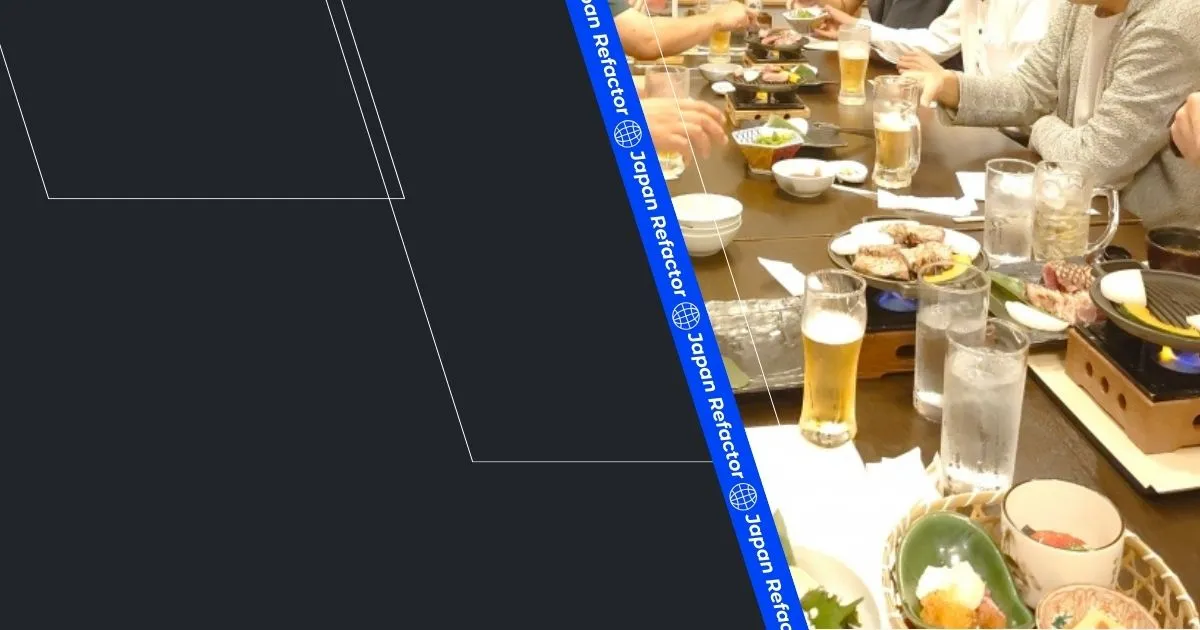

What is the most difficult protocol for foreign engineers to master at a JTC? Not the technical complexity, nor the daytime communication—the truly cryptic protocol exists at the izakaya after work. It is the “Nomikai.”
When I worked as an OBD engineer at a major Japanese automaker, accessing deep-layer ECU data required connecting directly to a physical diagnostic port. Surface-level behavior alone never reveals the true bottlenecks—and JTC organizational management follows the exact same architecture.
One day, completely deadlocked on a complex emission control issue, a veteran engineer said this at a Nomikai: “Why don’t you just let that process ‘sleep’ for a while, and ‘lock in’ the specs with the upstream team first?” That single sentence instantly cleared my vision.
The “true challenges” and informal decision-making processes invisible in the daytime office—the frontend—cannot be analyzed unless you connect to the physical port known as the Nomikai.
This article goes deeper than seat arrangements and drink-pouring etiquette. From reading the physical topology of the room to executing a clean session termination—this is your complete operator’s manual, treating the Nomikai not as a party, but as the secret backend of JTC organizational logic.
Why the Nomikai is the Secret Backend of JTC Decision-Making
In a JTC, a drinking session is not merely “after-work refreshment.”
This section explores the architectural necessity of the Nomikai, functioning as a High-Availability (HA) backend that processes critical organizational data invisible to the daytime frontend.
Beyond the Office: How “Nomikai Adaptive” Dynamics Shape Decision Making
Meetings in the office are often closer to a “ritual for rendering already decided items” (frontend rendering). Real discussions—such as which API to adopt or whose project receives the budget—are frequently settled in the relaxed environment of an izakaya. In these sessions, “Honne” (true feelings) emerges with the help of alcohol. Unless you understand these nomikai adaptive interfaces and the organizational dynamics of switching between official and unofficial modes, you will struggle to reach the core of the team, no matter how superior your code is.
Decoding the Source Code of Japanese Drinking Culture at Work
While “separation of work and life” is the base design in many countries, Japanese business drinking culture is built into the system as a specification to forcibly increase team cohesion. This is a feature, not a bug. During these sessions, a mode called “Bureiko” is activated, temporarily flattening the hierarchy. While daytime office operations are governed by the rigid Nenko Joretsu (Seniority System), where age and service years equal authority, these drinking sessions open a temporary bypass route for junior engineers to provide direct feedback to lead engineers that would normally be impossible.
High Context Communication and the Implicit Rules of the Izakaya
To hack any system, you must first understand its syntax. The closed space of an izakaya operates on numerous implicit rules and High Context Communication that are almost never documented for foreigners.
Seating Charts and Pouring Order: The Physical Syntax of JTC Socials
The seating arrangement is not random—it is a network topology. The diagram below shows the physical syntax of a standard izakaya table:
%%{init: {'theme': 'default', 'flowchart': {'nodeSpacing': 30, 'rankSpacing': 60}}}%%
flowchart LR
    subgraph SEAT ["🪑 Kamiza / Shimoza Logic"]
        direction LR
        Door["🚪 Door / Exit<br/>(Shimoza)"] --> Junior["⬇️ Shimoza<br/>Junior / Guest"]
        Junior --> Mid["➡️ Mid-rank<br/>Senior Staff"]
        Mid --> Boss["⬆️ Kamiza<br/>Boss / VIP<br/>(Far from door)"]
    end
    style Boss fill:#fef3c7,stroke:#d97706
    style Junior fill:#dbeafe,stroke:#2563eb
    style Door fill:#f1f5f9,stroke:#94a3b8
Rule: The person seated farthest from the door (Kamiza = “upper seat”) is the highest-status individual. Junior members sit closest to the exit (Shimoza = “lower seat”). Understanding this layout is your first act of Data Sniffing—it reveals the true power nodes before anyone has spoken.
Kanpai Timing Synchronization: You must never take a sip until every participant has a drink in hand and the highest-ranking person (or designated host) initiates the “Kanpai.” Think of this as a distributed system’s barrier synchronization—all processes must reach the checkpoint before execution continues. Breaking this synchronization is a critical protocol error.
Otoshi (お通し) Trap: Small dishes will be placed in front of you without being ordered. This is not a mistake or a gift—it is a mandatory “table charge” (approximately ¥300–600), equivalent to a connection fee for joining the session. You cannot refuse this packet. Attempting to send it back triggers an error state.
The Drink Ping: Never let someone’s glass reach empty before refilling it. Topping off a glass before it hits zero is not just politeness—it is an active “Ping,” signaling your willingness to continue providing resources and support to that individual. Who you Ping, and how promptly, is observed by everyone at the table.
Nomikai Operation Optimization: Mastering the Logic
To navigate the Nomikai environment efficiently, you must balance two operational modes: Resource Acquisition (leveraging sessions for career growth) and Resource Preservation (executing a clean exit).
By treating the session as a strategic process rather than a random event, you can maximize technical buy-in while minimizing social fatigue.
Leveraging Drinking Sessions for Technical Buy-in and Career Growth
You don’t need to avoid every session. When you want to push through a major change, such as a new architecture, secure a seat next to the key decision-maker.
While pouring a drink, casually mention, “Actually, there’s this new technology…” This can drastically reduce the latency of approval during the next day’s official meeting.
For a deeper dive into how these informal agreements lead to official approval, see our “What is the Ringi System & Process ?“
The “Soft Exit” Refusal: How to Say No Without Terminating Your Career
In Japan, saying a direct “No” is like sending a SIGKILL—it leaves a fatal log entry in the other person’s mind. Instead, implement a multi-layered defensive stack:
Step 1 — Pre-flag (Pretexting): A few hours before the session, set a “Pretext” by mentioning casually: “明日朝イチでデプロイがあるので” (Ashita asa-ichi de deploy ga aru node) — “I have a deployment first thing tomorrow morning.” This pre-registers your exit justification in everyone’s memory before the session even begins.
Step 2 — Smartwatch Alert: Set an alarm on your smartwatch. When it vibrates mid-session, glance at it with a slightly concerned expression and say: “すみません、ちょっとアラートが…” (Sumimasen, chotto alert ga…) — “Sorry, I just got an alert…” This is a legitimate-looking interrupt that triggers no suspicion in a technical workplace.
Step 3 — Detect the Termination Flag: Before executing your exit, scan the room for these signals:
flowchart LR
  subgraph INPUT ["📡 Scan Context"]
    direction TB
    DATA1["📉 Glass Rotation (Slow?)"]
    DATA2["🔁 Topic Loop (Repeating?)"]
  end
  subgraph LOGIC ["🧠 Parse Status"]
    direction TB
    CHECK{{"Exit Flag Detected?"}}
  end
  subgraph OUTPUT ["🏃 Action"]
    direction TB
    EXIT["🚪 Trigger Exit Sequence"]
    STAY["🍺 Stay (Keep Listening)"]
  end
  DATA1 & DATA2 --> CHECK
  CHECK -- "Yes (Flag=1)" --> EXIT
  CHECK -- "No (Flag=0)" --> STAY
  STAY -.-> INPUT
When glass rotation slows and topics begin looping (the group is replaying from the same memory address), critical information has stopped flowing. This is your green light to exit.
Step 4 — Execute the Exit Phrase (Soft Exit Library):
After the first venue closes, you will often hear “二次会行こう!” (Let’s go to the second round!). You are not obligated to attend. However, simply saying “I’m tired” is perceived as a low-effort rejection. The phrase library below includes a dedicated exit code for exactly this scenario.
| System Status | Executable Code | Use Case |
|---|---|---|
| Initiate Exit | そろそろ失礼します Sorosoro shitsurei shimasu | Universal soft close |
| Send Gratitude | 今日はありがとうございました Kyo wa arigatou gozaimashita | Always pair with above |
| Early Exit (pre-flagged) | 明日朝イチがあるので、これで失礼します Ashita asa-ichi ga aru node, kore de shitsurei shimasu | After Pretexting step |
| Alert-triggered Exit | ちょっと確認が入ってしまって… Chotto kakunin ga haitte shimatte… | After smartwatch alert |
| Nijikai Decline | 次の予定があるので、今日はここで Tsugi no yotei ga aru node, kyo wa koko de | Blocks second-round pressure |
Step 5 — Execute the O-saki-ni Function: The final phrase at departure is not one-size-fits-all. It is a function with branching logic:
flowchart LR
  START(("🏁 Initiate Exit"))
  CHECK{{"👤 Target Status?"}}
  RESULT_BOSS["👔 Boss / Senior → 'O-saki ni Shitsurei shimasu'"]
  RESULT_PEER["🍺 Peer / Junior → 'Otsukare! Mata ashita'"]
  START --> CHECK
  CHECK -- "Boss / Senior" --> RESULT_BOSS
  CHECK -- "Peer / Team" --> RESULT_PEER
“O-saki ni shitsurei shimasu” (お先に失礼します) acknowledges that you are leaving before your senior, framing your exit as apologetic rather than assertive. For peers, “Otsukare! Mata ashita” (お疲れ!また明日) is a lighter, collegial close. Using the wrong branch is a protocol mismatch—not catastrophic, but it creates unnecessary noise.
In 2026, while the frequency of these gatherings has decreased due to remote work, the relative importance of the occasional face-to-face Nomikai as a hub for High Context Communication has increased. It is not a waste of time; it is a powerful venue for social hacking within a JTC.
You now have the full stack: physical topology (Kamiza/Shimoza), synchronization rules (Kanpai), resource awareness (Otoshi, Drink Ping), and a clean termination sequence (Pre-flag → Alert → Termination Flag → Exit Phrase → O-saki-ni). Social hacking doesn’t end at the izakaya door.
The moment you return to the office, the interface switches from the fluid “Nomikai mode” back to the strict, formal state machine of the daytime workplace.
To navigate this linguistic protocol without a system crash, you must master the Business Keigo: A Logical State Machine for Software Engineers. It is the daytime counterpart to your nighttime social success.
Action Step: Use Your Next Team Dinner to Map the True Hierarchy
Here is a final piece of practical advice. At your next team dinner, keep your alcohol intake low and monitor the environment. Observe who pays the most attention to whose empty glass, and who laughs the hardest at whose jokes. There, you will see the “True Dependency Tree” visualized—one that never appears on the official org chart.
Use this insight as a weapon to navigate your life as an engineer in Japan more advantageously and smartly.
This article is a sub-module of Layer 1. To master the complete communication protocol or explore the entire career blueprint, choose your next destination:
🔼 Back to Layer 1: The Logic of Communication at Genba (Return to the module overview: Ringi, Nemawashi, and Genba Interaction)
🏠 Return to The Engineer’s Blueprint: Decoding Japanese Workplace Culture(Access the Master Manual including Technical Japanese, Career Strategy, and Business Etiquette)
📥 DOWNLOAD IT FOR FREE