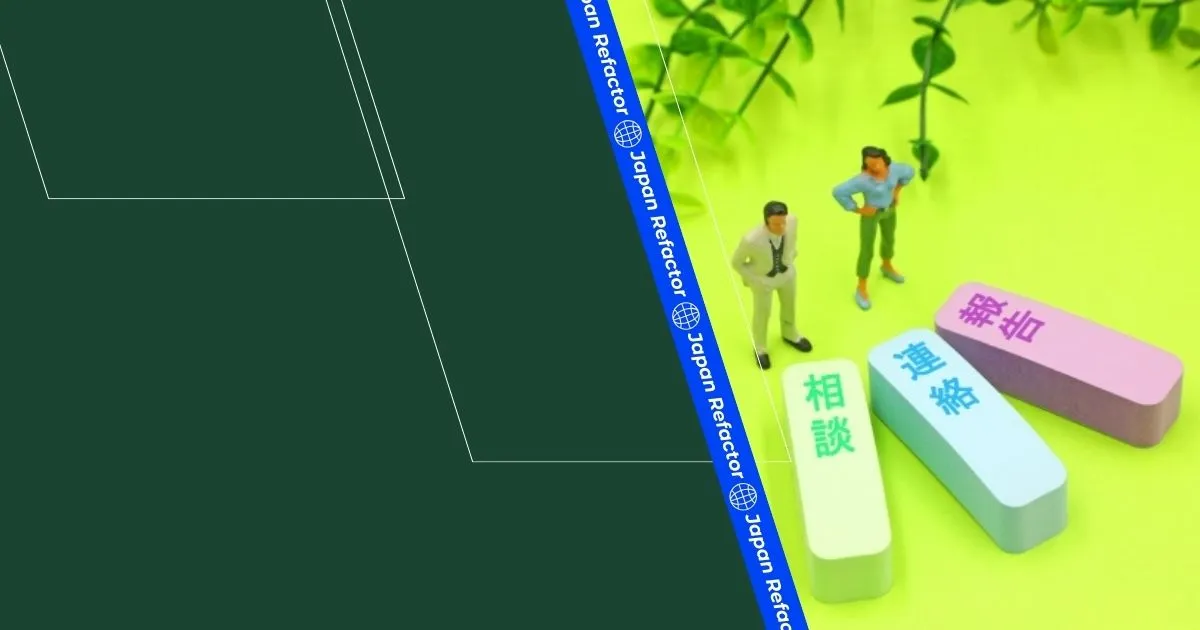

For engineers jumping into the Japanese tech industry from overseas, the “unique local workflow” often presents a higher wall than the technology itself. Specifically, Horenso (Report-Inform-Consult) is frequently misunderstood by autonomy-seeking developers as micromanagement or excessive surveillance.
However, within the context of Japanese project management, this is not about monitoring individuals; it is an essential process for synchronizing the state of the entire system. From my perspective as a former OBD engineer at an automaker, Horenso is not just a matter of Japanese business etiquette—it is a logical “communication protocol” designed to keep projects stable. In vehicle control development, even the most brilliant code could trigger a system-wide fail-safe if communication timing drifted by just 1 millisecond.
The Japanese organization operates as a similar “distributed system.” Engineers are not expected to function as standalone units but must maintain synchronization through frequent “packet exchanges” of information. In this article, we will hack this unique Japanese engineering culture through the lens of system design to help you gain trust as a logical developer.
The Infrastructure: Why Japan Runs on Consensus
In a Japanese development environment, a single “genius” rarely makes all the calls. Instead, the process prioritizes building a team-wide agreement. Let’s decode the architectural philosophy behind this cautious approach.
Understanding the Consensus Culture
graph LR
    Start[📥 Input Status] --> Dev{Event Type?}

    subgraph CI [🔄 Continuous Integration]
        Ren[📊 Renraku / Contact] --> Sync[✅ Sync State]
    end

    subgraph CD [🚀 Continuous Deployment]
        Hok[📝 Hokoku / Report] --> Dep[🎉 Deploy Update]
    end

    subgraph Bug [⚠️ Exception Handling]
        Sod[🆘 Sodan / Consult] --> Fix[🔧 Fix Logic]
    end

    Dev -- Routine --> Ren
    Dev -- Milestone --> Hok
    Dev -- Issue --> Sod

    style CI fill:#e0f2fe,stroke:#0284c7,stroke-width:2px,color:#0c4a6e
    style CD fill:#d1fae5,stroke:#059669,stroke-width:2px,color:#064e3b
    style Bug fill:#fee2e2,stroke:#dc2626,stroke-width:2px,color:#991b1b
    style Start fill:#f3f4f6,stroke:#333
The key to navigating the Japanese organizational structure lies in moving as an optimized cluster rather than a standalone node.
Distributed System with Shared Memory: The Japanese “Shared Memory” Org Model
The Japanese management style prioritizes “shared memory” over “local variables” (individual discretion). By constantly updating everyone’s memory to the latest state, the system ensures that no contradictions occur, regardless of who makes a decision or if a member leaves the team.
The Cost of “Surprises”: When Unforeseen Bugs Cause Deadlocks
To an engineer, the most terrifying thing is an unexpected bug right before deployment. In Japan, a failure to report is viewed as an “undefined exception.” Reporting a problem at the last minute is seen as a risk that pushes the entire system into a deadlock, potentially destroying the release cycle.
Horenso as a Sync Protocol
Horenso is the specific engineering method used to support this consensus culture. Rather than a chore, think of it as a data synchronization process.
Continuous Integration for Information: Horenso as Information CI/CD
flowchart LR
    subgraph "報告 (Hokoku) = Report"
        H1["📊 Status Report<br/>= git push"]
    end
    subgraph "連絡 (Renraku) = Inform"
        R1["📢 Share Info<br/>= broadcast event"]
    end
    subgraph "相談 (Sodan) = Consult"
        S1["💬 Ask for Input<br/>= code review request"]
    end
    H1 --> PIPE["🔄 Team Sync<br/>Pipeline"]
    R1 --> PIPE
    S1 --> PIPE
    PIPE --> DASH["📺 Manager Dashboard<br/>= Monitoring"]
    DASH --> TRUST["🛡️ Trust Level UP<br/>= More Autonomy"]
    style H1 fill:#dbeafe,stroke:#2563eb,color:#1e3a5f
    style R1 fill:#fef3c7,stroke:#d97706,color:#92400e
    style S1 fill:#f3e8ff,stroke:#7c3aed,color:#4c1d95
    style PIPE fill:#e0f2fe,stroke:#0284c7,color:#0c4a6e
    style TRUST fill:#d1fae5,stroke:#059669,color:#064e3b
Think of Horenso as CI/CD for information. Instead of pushing a massive “report” (change) all at once, you perform small, frequent merges (sharing) to minimize conflicts and misunderstandings.
This “Information CI/CD” mindset should extend directly into your repository. In a JTC environment, your Git commit messages are often the most frequent Horenso packets you’ll send. Standardizing these messages ensures your “local changes” are perfectly synced with the team’s “shared memory” without manual overhead.
→ Standardize your pushes: Japanese Git Commit Message Format: A Cheat Sheet for Expat JTC Developers
Effective status reporting: Managers Want the Current “State”
When a Japanese manager asks “How is it going?”, they aren’t necessarily demanding a finished product. They want to know your current “State” (Running, Pending, or Error). Just as OBD scans engine conditions to control the check engine light, you must provide effective status reporting by streaming your progress. This consistent data stream is what defines the Japanese engineering culture, ensuring every node in the organization stays synchronized.
The Backend: Nemawashi and the Ringi System
flowchart TB
subgraph Daily["📅 Daily Operations"]
HO["報告 Hokoku"] --> SYNC["🔄 Team Sync State"]
RE["連絡 Renraku"] --> SYNC
SO["相談 Sodan"] --> SYNC
end
SYNC --> INFO["✅ All nodes<br/>have latest info"]
INFO --> RINGI["📋 Ringi Submission"]
RINGI --> APP1["👨🏫 Lead: No surprises → ✅"]
APP1 --> APP2["👨💼 Manager: Informed → ✅"]
APP2 --> APP3["🏢 Director: Aligned → ✅"]
APP3 --> DONE["🚀 Approved!"]
NO_SYNC["❌ Skipped Horenso"] --> DELTA["⚠️ Information Delta"]
DELTA --> FAIL["🚫 Ringi Rejected<br/>'I wasn't informed'"]
style Daily fill:#f0f9ff,stroke:#0284c7
style DONE fill:#d1fae5,stroke:#059669,color:#064e3b
style FAIL fill:#fee2e2,stroke:#dc2626,color:#991b1b
style NO_SYNC fill:#fee2e2,stroke:#dc2626,color:#991b1bBehind every smooth Horenso flow, there is a backend process:
Nemawashi (pre-meeting dependency resolution) and the Ringi system (multi-signature final commit). If your daily Horenso is lacking, these approval pipelines will stall.
→ Complete technical guide to Nemawashi & Ringi : What is the Ringi System & Process? Guide for Engineers in Japan (2026)
Implementation: Mastering Technical Japanese Vocabulary
Now that we understand the theory, let’s look at the implementation. Certain phrases in the Japanese workplace function as “Error Messages” or “Reserved Words.”
Fatal Errors: Decoding “Kento Shimasu”
When a manager says “Kento shimasu,” it often signals a “403 Forbidden” — your Horenso data was insufficient.
Start a “Sodan” (consultation) to break the deadlock.
→ Full decoder for Japanese business phrases : The “Yes, but No” Dictionary
Essential Technical Japanese Vocabulary for Engineers
| Japanese | Romaji | Engineering Interpretation |
|---|---|---|
| なる早 | Naru-haya | ASAP. High-priority task. |
| 調整中 | Chosei-chu | In Adjustment. Resolving dependencies with other departments. |
| 共有 | Koyu | For info. No action required, but please load into memory. |
| たたき台 | Tataki-dai | Beta version / Draft. Unfinished proposal for feedback. |
Conclusion: Optimizing Your Career in Japanese Engineering Culture
It is easy to dismiss Japanese business etiquette as an “irrational legacy habit.” However, if you hack it as a “system protocol for high reliability and availability,” you can drastically optimize your career.
By mastering the Japanese management style and calling the Horenso API correctly within the Japanese engineering culture, your “Trust Score” will skyrocket. By navigating the Ringi system and Nemawashi with technical precision, you transform from an outsider into a key architect of the system. Once you master these sync processes, you will find a stable environment with more significant autonomy and team backup than you might find elsewhere.
In your next stand-up meeting, try sharing your progress at the “10% mark.” It will be your first, and strongest, commit toward maximizing your value in the Japanese market.
Next Steps: Level Up Your Navigation
This article is a sub-module of Layer 1. To master the complete communication protocol or explore the entire career blueprint, choose your next destination:
🔼 Back to Layer 1: The Logic of Communication at Genba (Return to the module overview: Ringi, Nemawashi, and Genba Interaction)
🏠 Return to The Engineer’s Blueprint: Decoding Japanese Workplace Culture(Access the Master Manual including Technical Japanese, Career Strategy, and Business Etiquette)
📥 DOWNLOAD IT FOR FREE