
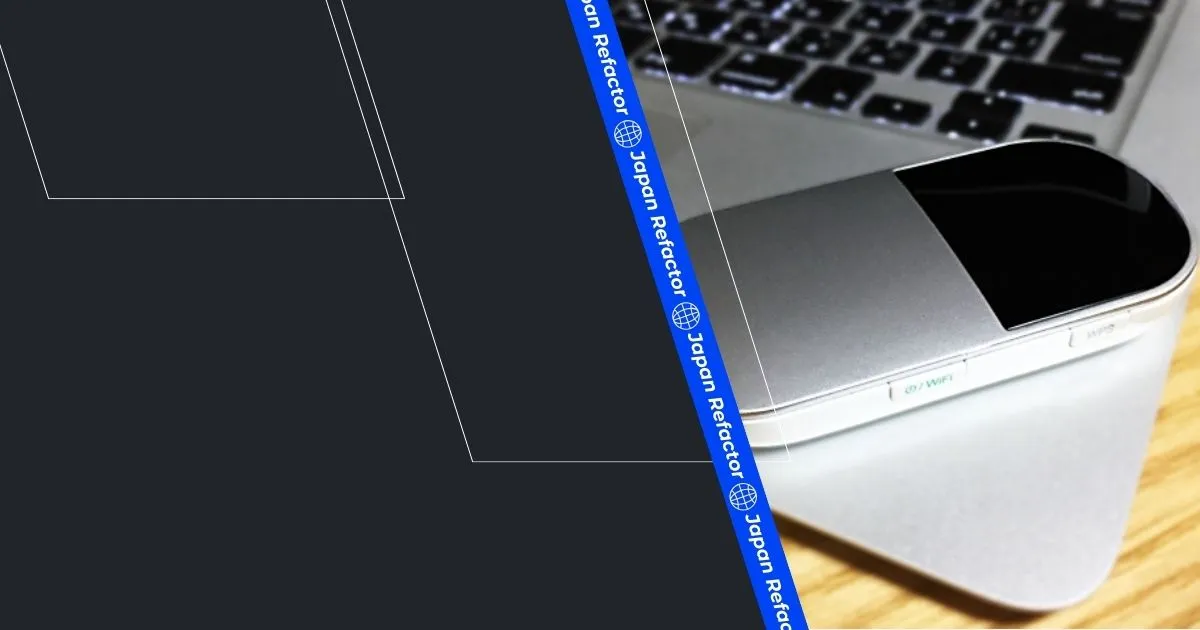

Welcome to Japan! You’re likely excited to set up your new life and development environment. However, many foreign engineers moving to Japan face a significant bottleneck: the “abnormally long wait times for home internet (fiber optic) installation.”
Even in major urban centers like Tokyo’s 23 wards or Osaka, the moving season in spring (March to April) can see average wait times of 6 to 8 weeks from application to activation. In regional cities, this can vary greatly and sometimes take nearly three months. Without a strategic backup plan, your daily life and work will face major disruptions.
That’s why choosing a reliable “best pocket wifi japan” and a trusted “japan esim for tourists/expats” can save you time and prevent interruptions to your work.
This article explains how to survive this “internet dead zone,” a period often prolonged by traditional Japanese corporate culture (JTC).
The “Home Internet Wait”: Surviving Japan’s Infamous Installation Delays
While the quality of home internet in Japan is world-class, getting it activated requires passing a “test of patience.” Here, we’ll break down why it takes so long and why these delays are a critical risk for engineers.
The Reality of Setting Up Internet in Japan: Slow ISPs and Paperwork
Many Japanese ISPs (Internet Service Providers) still rely on physical paperwork, phone calls, and on-site technician visits. During the peak moving season (March–April), bookings surge, and waiting 1–2 months is common. For foreign engineers, navigating complex Japanese documents and the slow-moving processes typical of JTC (Japanese Traditional Company) culture is the first major hurdle.
Why a Reliable Local Connection is Crucial for Remote Work and Slack
Living without internet for 1–2 months is a deal-breaker for engineers. Free cafe Wi-Fi is a security risk, and even with a VPN (see Japanese VPN for details), speeds are often unstable.
For instance, downloading Docker images (approx. 1GB–2GB), pushing large Git repositories (several GBs), or real-time communication via Slack/Zoom will frequently hit timeouts or latency issues on shared public networks. To maintain a seamless workflow, a dedicated, stable connection is indispensable.
The Best Pocket WiFi Japan Has to Offer for Heavy-Data Tech Workers
A pocket WiFi will serve as your primary connection until your home fiber is active. For tech workers searching for the “best pocket wifi japan,” data capacity and support quality are the most critical criteria. Here are the top contenders specialized for expats.
Sakura Mobile vs. Ninja WiFi: The Top 2 Choices for English Support
The two most popular providers within the foreign engineer community are Sakura Mobile and NINJA WiFi.
Sakura Mobile utilizes the NTT Docomo network, offering impressive 20-hour battery life and robust English customer support. With average download speeds of 50–80 Mbps and a Ping of around 30ms, it provides the reliability needed for professional development.
NINJA WiFi, on the other hand, is highly rated for its data quality, flexible plans, and smooth airport pickup. Even for short-term use, it maintains stable speeds (40–70 Mbps) for Git pushes and Zoom meetings.
Choose Sakura Mobile if you want guaranteed English support for technical queries. Choose NINJA WiFi if you prioritize short-term cost-performance and convenient pickup.
➢ Sakura Mobile: Check English support & Docomo network stability
➢ NINJA WiFi: Pick up at the airport and connect your MacBook immediately
No-Contract Devices with Unlimited Data to Bridge the 1-2 Month Gap
Since this is a “bridge” until your ISP installation is complete, choosing a plan without a 2-year “contract trap” (binding period) is a mandatory requirement. Comparing monthly costs and identifying true “unlimited” limits will ensure a smooth transition once your fiber optic line is ready.
For example, options like Sakura Mobile’s “No-Contract & Unlimited Data” plan(link) allow you to handle Docker/GitHub tasks and Zoom meetings for approximately 6,000 JPY per month without worry. You can cancel anytime without penalty fees. This is the optimal solution for expats and remote workers to build a high-performance environment without data caps.
The Ultimate Japan eSIM for Tourists/Expats Needing Immediate Connectivity
While pocket WiFi is powerful, an eSIM is your best friend for the “first few days” before your device arrives or as a secondary line when out and about. Here is the latest on the “japan esim for tourists/expats” scene for instant connectivity upon arrival.
Ubigi and Airalo: Getting Online Before Leaving Narita/Haneda Airport
No more lining up at airport counters for physical SIM cards. By using the Ubigi or Airalo apps to scan a QR code and install a profile beforehand, you can start using data the moment you touch down at Narita or Haneda Airport.
Airalo offers a variety of affordable 1GB–5GB plans with an intuitive UI. You can even get started with a $3 discount coupon on your first purchase.
Ubigi runs on the NTT network with stable 20–30ms Ping and solid upload/download speeds, capable of handling emergency bug fixes (Hotfixes) and Git operations via your laptop.
📱The Professional’s Choice: Permanent Japanese Phone Number
While tourist eSIMs like Airalo or Ubigi are great for data, they don’t provide a local Japanese phone number (070/080/090). For engineers moving to Japan, having a real phone number is a “mandatory prerequisite” for opening bank accounts, signing apartment contracts, or completing your Resident Card registration.
I highly recommend Mobal Japan eSIMs (Voice + Data). They are one of the few providers that offer a full voice plan with no complicated long-term contracts. You can secure your number before you even land, ensuring your “Identity Protocol” is active from Day 1.
Note: Having a voice-enabled number is the “Primary Key” for almost all administrative tasks in Japan. Mobal allows you to complete the identity verification online, so your number is ready for “production use” the moment you clear immigration.
Cost-Effective Data Plans vs. Developer-Ready Tethering Capabilities
When choosing an eSIM, match the plan to your use case.
Airalo is perfect for daily use on the go, such as checking Slack or using Google Maps.
Ubigi, however, is renowned for its stable “Tethering (Hotspot)” functionality. It is highly recommended for those who need a “Developer-Ready” environment to open a laptop and push a Hotfix in an emergency. If you need high-quality tethering on a stable NTT-based network, choose Ubigi.
➢ Airalo: Easy-to-start 1GB eSIM (Apply $3 off coupon)
➢ Ubigi: Get the high-quality tethering environment engineers demand
The “Dev Survival Setup”: Combining Both Before Fiber Optic Arrival
Relying on a single communication method is the same as creating a “Single Point of Failure (SPOF)” in system design. Here is the ultimate practical setup to survive the wait for fiber installation by combining “best pocket wifi japan” and “japan esim for tourists/expats.” This ensures developers can maintain workflow continuity, Git operations, and video meetings without downtime.
Using eSIM for Daily Commutes and Pocket WiFi for Video Calls & Git Commits
Set your eSIM (Ubigi or Airalo) as your smartphone’s primary line for daily info-gathering and chat notifications.
For development work at home or in cafes, prioritize your pocket WiFi (Sakura Mobile, etc.) to ensure stability for Zoom meetings, Git pushes, and Docker image downloads.
To avoid a SPOF, you can also configure automatic retries for Git pushes and keep your eSIM as a standby backup for Zoom calls. Defining these “ops rules” maximizes your environment’s availability until your fiber line is active.
Final Step: Wait for Fiber Optic Installation with Peace of Mind
Use this “eSIM + Pocket WiFi” survival setup to bridge the first 1–2 months while referencing Moving to Japan for a smooth transition. Once your fiber optic (Hikari Internet) is active, simply return the pocket WiFi and switch your mobile line to a local MVNO for a permanent, cost-effective network setup.
Conclusion: The “Engineer’s Survival Setup”
We’ve covered how to navigate the internet activation gap often influenced by traditional JTC culture. Choose the service that fits your needs from the table below:
| Need | Recommended Service | Key Features |
| Primary line (1 month+) | Sakura Mobile | English Support, Unlimited, No Contract |
| Instant Airport Pickup | NINJA WiFi | No Setup, Same-day Pickup, Good for Short-term |
| Cheapest / Instant Activation | Airalo | App-based, $3 Off Coupon Available |
| Stable Tethering for Dev | Ubigi | NTT Docomo Network, Low Latency |
This article is a sub-module of Layer 3. To master the complete career optimization protocol or explore the entire blueprint, choose your next destination:
🔼 Back to Layer 3: Career Strategy & Hacking Seniority (Return to the module overview: Salary Negotiation, Visa Hacks, and Promotion Logic)
🏠 Return to The Engineer’s Blueprint: Decoding Japanese Workplace Culture (Access the Master Manual including Genba Communication, Tech Specs, and Business Etiquette)
📥 DOWNLOAD IT FOR FREE